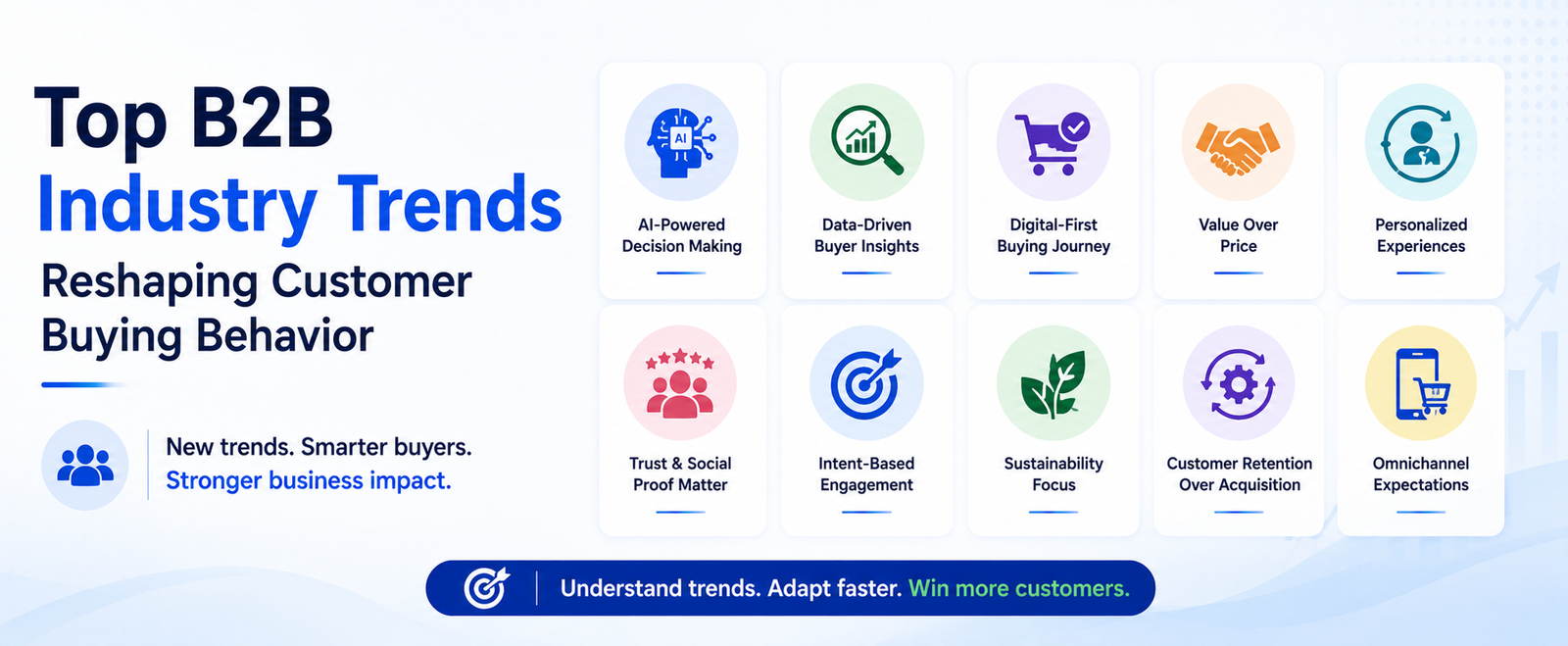
The gap between B2B and B2C buying behavior keeps narrowing. Business buyers now expect the same self-serve research experience they get as consumers, and that shift is changing how companies need to show up long before a sales conversation starts.
1. More of the Buying Journey Happens Without Sales
One clear trend is the growing share of the buying journey that happens without a salesperson in the room.
Buyers read reviews, compare pricing pages, and watch product demos on their own time, often reaching a shortlist before anyone from the vendor knows they exist.
Companies that used to rely on gatekeeping information are having to rethink that approach entirely.
2. Buying Committees Are Getting Larger
Committee-based buying has also expanded. Where a single manager might once have approved a purchase, it's increasingly common for five or more stakeholders across departments to weigh in, each with different priorities.
This has made short, punchy sales pitches less effective than resources that different roles can review independently.
3. Buyers Want Outcome-Based Proof
There's also a noticeable shift toward outcome-based evaluation. Buyers care less about feature checklists and more about proof that a solution solved a comparable problem for a comparable company.
Case studies, peer benchmarks, and customer references carry more weight in 2026 than product spec sheets do.
4. Pricing Transparency Is Increasing
Pricing transparency is another area seeing real change. More companies are publishing pricing openly rather than forcing a "contact sales" conversation.
This is partly because buyers now treat pricing opacity as a red flag rather than a normal part of enterprise sales.
5. Buyers Are More Focused on Risk
Finally, risk aversion has grown across most industries, driven by tighter budgets and more scrutiny on spending.
Buyers are asking harder questions about implementation time, support quality, and what happens if the vendor doesn't deliver.
This means trust signals now matter as much as the product itself.
Relationships Still Matter — But Later
None of this means relationship-driven selling is dead. It means the relationship starts later in the journey, after buyers have already formed an opinion based on what they found on their own.
Businesses that adapt their content, pricing, and proof points to that reality are the ones staying ahead.